Celestial Resilience: Why ASTM F136 Titanium Transforms Cartilage Healing
The Architecture of Modern Ear Curation
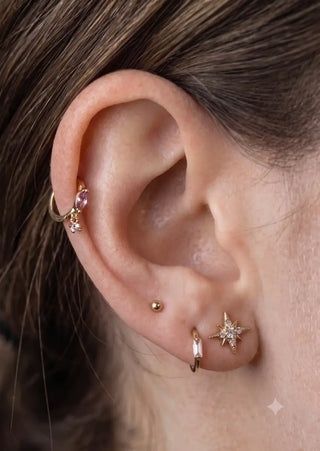
Constellation piercings have moved beyond decoration. A carefully arranged ear now functions like a miniature architectural composition, balancing negative space, scale, metal tone, and movement across the helix, conch, tragus, and lobe. Yet the most sophisticated curation is not defined by appearance alone. Every stud, hoop, and flat-back post must also coexist with living tissue during a demanding healing process. The right design is therefore both visual and biological, aligned with the anatomy beneath it.
Cartilage presents a more exacting challenge than the soft, vascularized lobe. Its structure receives nutrients and immune support largely through diffusion from surrounding tissue rather than through a dense direct blood supply. That limited circulation helps explain why cartilage can remain tender for months and why pressure, friction, contamination, or an unsuitable alloy may trigger prolonged irritation. For clients seeking an elevated result without unnecessary drama, bespoke jewelry curation should begin with implant-grade materials. ASTM F136 titanium has earned its place as a leading choice because its surface chemistry and mechanical performance are designed to remain in harmony with the body.
Understanding Cartilage Healing and the Biology of Avascular Repair
Cartilage is not simply a thicker version of the earlobe. Chondrocytes, the cells responsible for maintaining cartilage, rely on nutrients and oxygen moving through the perichondrium, the connective-tissue layer surrounding cartilage. When a piercing passes through this area, the body must establish a stable epithelialized channel while managing inflammation in tissue with comparatively limited vascular access. The process is gradual, and the apparent calm of the outer skin does not necessarily mean the deeper channel is fully mature.
Healing commonly takes four to twelve months, although individual anatomy, placement, jewelry, health, and aftercare can extend that period. A helix may be repeatedly compressed by a pillow, headphones, hair, or a phone. A conch can experience pressure from earbuds or accidental contact during styling. These small events may seem insignificant, but repeated microtrauma can keep the inflammatory response active and encourage swelling, crusting, or a persistent irritation bump.
The biological environment is only half of the equation. Mechanical stability and metallurgical compatibility determine how calmly that environment develops. A post that is too short can compress swollen tissue; one that is too long can catch on clothing and transmit force into the channel. An uneven surface can scrape newly formed tissue every time the jewelry moves. For discerning clients, verified implant-grade titanium pieces designed specifically for delicate cartilage tissue provide a more reliable foundation than attractive jewelry with unknown specifications.
- Limited vascularity can slow delivery of oxygen and immune support.
- Repeated pressure may prolong inflammation and encourage angle changes.
- Improper dimensions can cause embedding, catching, migration, or unnecessary trauma.
- Unverified alloys may introduce nickel or other irritants into a healing wound.
Cartilage infections also deserve serious attention. Medical literature notes that cartilage piercings carry greater infectious risk than lobe piercings because limited vascularity can make infection more difficult to contain. Increasing pain, heat, spreading redness, marked swelling, fever, or unusual discharge should be assessed promptly by a healthcare professional. A bump is not automatically an infection, but neither should persistent or worsening symptoms be treated as a purely cosmetic inconvenience.
The Metallurgical Secret of ASTM F136 Implant-Grade Titanium
ASTM F136 identifies a specific titanium alloy intended for surgical implant applications: Ti-6Al-4V ELI, or titanium with aluminum and vanadium in an extra-low-interstitial formulation. ASTM International establishes technical specifications covering composition, processing, and performance. The ELI designation matters because tightly controlled interstitial elements, including oxygen, nitrogen, carbon, and iron, support the material”s demanding implant profile. It is not merely a stylish label for any gray-colored titanium.
Titanium rapidly forms an extremely thin, stable layer of titanium dioxide, commonly written as TiO2, when exposed to oxygen. This passive oxide film acts as a protective barrier between the alloy and surrounding tissue, helping limit corrosion and metal-ion release. Titanium is also light, strong, and naturally nickel-free when the correct alloy is used. Those qualities make it particularly attractive for cartilage, where lower weight can reduce downward pull and where nickel sensitivity may present as itching, rash, redness, or persistent irritation.
| Material | Key consideration for healing cartilage | What to verify |
|---|---|---|
| ASTM F136 titanium | Implant-grade specification, light weight, corrosion resistance, and stable passive oxide layer | Material documentation or mill certificate |
| Commercial titanium | May be suitable in some applications, but the label alone does not confirm implant compliance | Exact grade and recognized standard |
| Surgical steel | Some grades can contain nickel and “surgical” is not, by itself, a body-jewelry certification | Specific ASTM or ISO designation |
| Brass or mystery alloys | Composition and surface stability may be uncertain, increasing irritation and discoloration concerns | Complete alloy disclosure |
Gold-colored finishes require similar scrutiny. Plating, PVD coatings, gold-fill, and vermeil can wear or expose an underlying metal, and a finish suitable for healed wear is not automatically appropriate for a fresh piercing. The Association of Professional Piercers standards emphasize materials that meet recognized surgical implantation standards, along with smooth construction and appropriate sizing for initial piercings. For a warm finish during healing, a piercer may recommend a verified solid gold option that meets the relevant requirements, rather than relying on an attractive coating.
Banishing the Piercing Bump Through Surface Science
Not every bump means the same thing. A keloid is an overgrowth of scar tissue that extends beyond the original wound and may continue enlarging. A hypertrophic scar remains within the wound”s boundaries but can become raised and firm. More commonly around cartilage, a friction or irritation bump reflects mechanical stress, trapped moisture, pressure, jewelry movement, or a reaction to the material. These conditions can look similar, so persistent growth, severe discomfort, or uncertainty warrants evaluation by an experienced piercer and, when appropriate, a medical professional.
Surface finish is one of the least visible but most consequential features of jewelry. A properly polished, consistent surface reduces microscopic irregularities that can drag across the epithelial channel. Internal threading and threadless construction also avoid exposing rough external threads to fresh tissue during insertion. The APP explains that irregular surfaces can tear healing tissue, delay epithelialization, and create spaces where debris and microorganisms may collect. A mirror-like finish is therefore not simply a luxury detail. It is functional engineering at the scale where tissue meets metal.
Research into titanium and infection control is developing, but claims should remain precise. A rabbit jaw study examined titanium plates coated with the antimicrobial peptide caerin 1.9 and found reduced bacterial signals and inflammatory changes in the coated group. That work, published in an open-access medical journal, does not prove that ordinary piercing jewelry is antimicrobial, nor does it eliminate the need for sterile technique. It does reinforce a broader principle: material surface, coating, bacterial interaction, and tissue response are closely connected, and laboratory findings should not be overstated for consumer use.
- Choose smooth, highly polished surfaces with no visible scratches, pits, or polishing residue.
- Favor internally threaded or threadless designs for fresh piercings.
- Keep weight modest, especially in helix, forward helix, and thin cartilage placements.
- Reduce contact points with flat backs and profiles suited to the anatomy.
- Do not diagnose a bump by appearance alone; worsening symptoms need professional assessment.
Weight deserves particular attention in an upscale curation because visual impact does not require physical bulk. A heavy hoop can create gravitational drag, while a large charm may repeatedly rotate and pull on a healing channel. Lightweight titanium allows a standout arrangement without asking delicate cartilage to support unnecessary mass. The result is cleaner in both silhouette and biology, especially when several piercings are positioned in close orbit.
A Curated Checklist for Long-Term Cartilage Wellness
Begin with anatomy, not a saved image. A qualified piercer should assess tissue thickness, existing angles, ear shape, sleeping habits, headphones, eyewear, and the intended sequence of future piercings. The initial piece should be long enough to accommodate predictable swelling without becoming a snag risk, and the gauge, diameter, and backing should suit the placement. Jewelry must be sterile, smooth, securely assembled, and made from a documented material. A mill certificate or traceable manufacturer information is far more useful than a vague “hypoallergenic” claim.
- Confirm the material. Ask for ASTM F136 titanium documentation, or another recognized implant standard appropriate to the piece.
- Evaluate the construction. Look for threadless or internally threaded components, smooth edges, clean settings, and no exposed rough threads.
- Check the initial fit. The post should allow swelling but should not hang so far that it catches on hair, masks, or bedding.
- Plan the downsize. Once early swelling has settled, have a professional assess whether a shorter post is appropriate. Timing varies, and premature changes can disturb the healing channel.
- Keep aftercare simple. Use sterile saline as directed, rinse away residue when appropriate, dry gently with a clean disposable product, and avoid twisting or rotating the jewelry.
- Monitor the trend. Gradual improvement is reassuring; escalating pain, heat, spreading redness, fever, or concerning discharge requires medical guidance.
The downsize window is especially important. An overly long post can move, catch, and create leverage that gradually changes the piercing angle. Yet replacing jewelry too early, or attempting a change while the channel is fragile, can cause fresh trauma. A professional piercer should decide when the swelling has sufficiently resolved and should perform the change with appropriate tools and hygiene. A healed piercing is generally no longer tender, actively crusting, or secreting, but timelines remain individual rather than fixed to a calendar.
Hands-off healing is a disciplined ritual, not passive neglect. Clean hands before any necessary contact, keep cosmetics and hair products away from the site, and avoid sleeping directly on fresh cartilage. Do not use alcohol, hydrogen peroxide, aggressive scrubs, or improvised essential-oil treatments, as these can damage healing tissue. Saline should support the process without becoming an excuse for constant soaking or handling. The most elegant result often comes from doing less, consistently and correctly.
Elevate Your Ear Curation to Celestial Standards
High-grade jewelry should be viewed as an investment in biological longevity, not disposable adornment. The visual language of a refined ear depends on proportion and finish, but the lasting success of that composition depends on tissue health. ASTM F136 titanium offers a strong starting point because its documented alloy specification, passive oxide behavior, light weight, and corrosion resistance address several of cartilage”s most persistent challenges at once.
Ask direct questions before a needle ever meets the ear. Request the exact material designation, evidence of traceability, information about surface finishing, and confirmation that the post length and construction fit the planned placement. A studio that can explain its metallurgy with the same care it brings to styling is better positioned to create a curation that remains comfortable, stable, and visually coherent. Downtown polish and medical-grade thinking are not competing aesthetics. Together, they create an ear arrangement designed to stay in orbit for years.
