Constellations on Celluloid: How Mid-Century Flash Sheets Documented American Folk History
Luminous Cartography on Lower East Side Walls
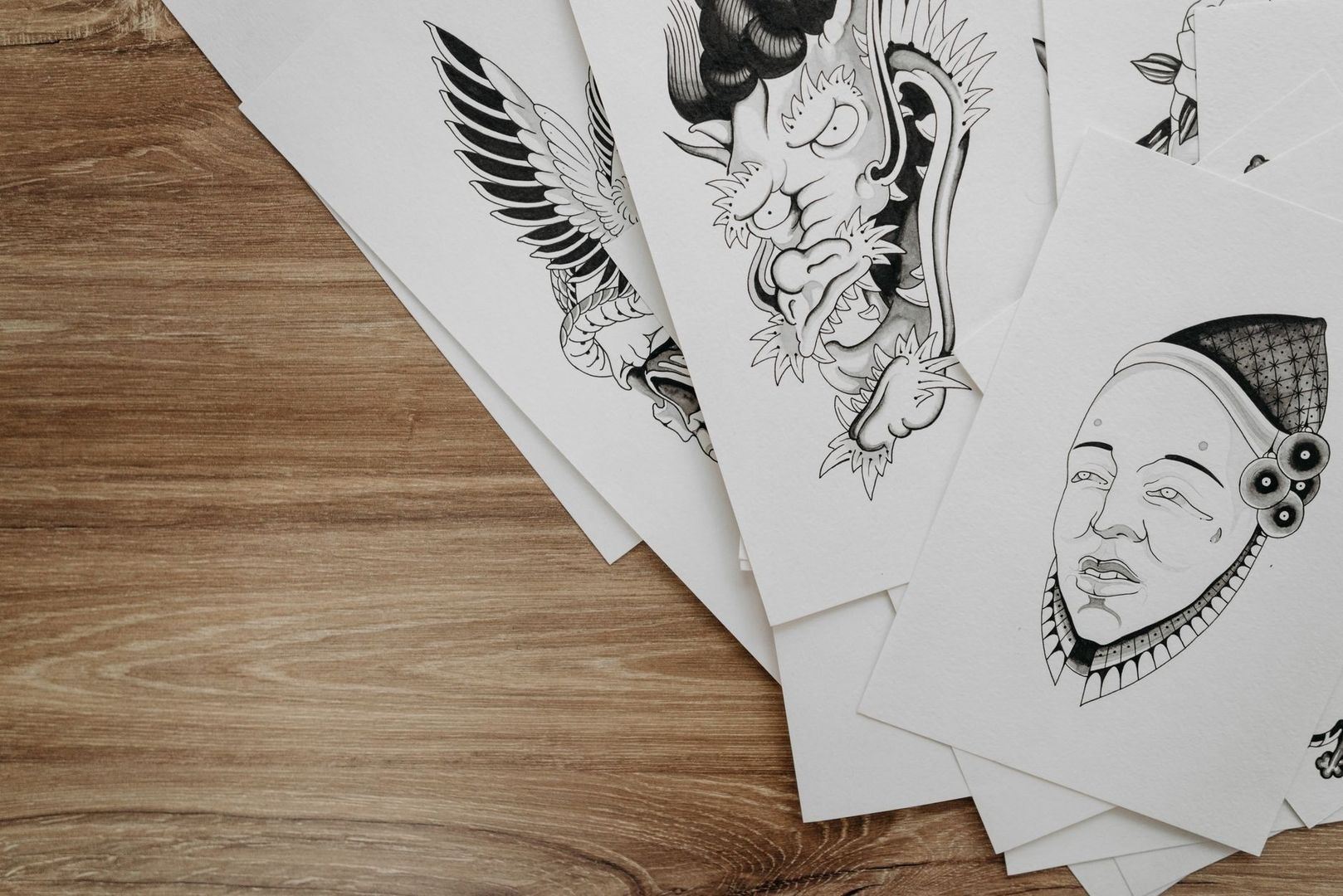
Mid-century tattoo flash was never merely studio decoration. It was a working visual lexicon, designed to be scanned quickly by sailors, soldiers, dockworkers, laborers, and urban travelers who needed a symbol that could carry identity across workplaces, borders, and years. Pinned to walls or arranged in layered displays, these sheets translated private hopes into a public vocabulary: a heart for devotion, an eagle for national belonging, a star for direction, a swallow for return.
New York was one of the places where that vocabulary became especially dense. Its waterfronts, military traffic, immigrant neighborhoods, and commercial streets brought together wartime anxiety, migratory ambition, and the practical rituals of working life. The Lower East Side and the Bowery formed a particularly charged orbit, where tattooers adapted inherited motifs to changing customers and where images moved between skin, paper, machines, and memory. Today, the shift from subterranean craft to documented cultural artifact mirrors a broader change in American modernism, as vernacular forms once dismissed as crude or disposable are recognized as records of lived history. The Smithsonian”s tattoo flash archive offers one authoritative point of entry into that transformation, while its Authoritative Source provides a related institutional record.
The Chemistry of Survival from Acetate to Paper Flash
Before the polished paper sheets associated with many traditional shops, tattoo designs circulated through a more immediate and tactile system. Tattooers could cut designs into celluloid or acetate, creating stencils that transferred an outline to the client”s skin. In some accounts of older practice, powdered lampblack was rubbed through the stencil, leaving a workable guide for the electric needle. The process was economical, repeatable, and suited to a trade in which speed mattered. A design did not need to exist as a finished illustration; it needed to survive contact with a busy shop, a moving customer, and the uneven surface of the body.
Acetate also preserved the practical intelligence of individual tattooers. It could be stored, reused, altered, and passed between practitioners, carrying evidence of changing line weights and technical habits. Later flash sheets made the same visual system more legible to customers. Hand-painted boards and paper sheets presented clusters of designs in bright, controlled arrangements, allowing a patron to select a ship, anchor, eagle, pin-up, or military emblem in minutes. The display was a catalog, a sales tool, and a compact archive of the shop”s taste.
The contrast between production media and display materials reveals how adaptable the trade became. Stencils and acetates were working instruments, valued for their precision and durability. Paper flash was public-facing, valued for color, composition, and immediate recognition. A sheet might repeat familiar motifs while adjusting proportions, lettering, or decorative details to distinguish one artist”s hand from another. Surviving examples in institutional collections show how pragmatic utility evolved into fine vernacular design, with every outline and color decision calibrated for distance, speed, and memory.
| Material | Primary function | Historical significance |
|---|---|---|
| Celluloid and acetate | Reusable stencil and design guide | Records the technical economy of working tattoo shops |
| Powdered lampblack | Transfer medium for outlines | Shows how image-making depended on inexpensive, available materials |
| Hand-painted paper flash | Customer display and selection tool | Turns a practical catalog into a composed visual environment |
| Business cards and shop ephemera | Promotion and professional identity | Connects individual tattooers to local networks and reputations |
Decoding the Constellations of Waterfront Symbolism
The classic motifs of American traditional tattooing functioned as a symbolic navigation system. Nautical stars suggested orientation and safe passage, while swallows carried associations with travel, loyalty, and the hope of returning home. Eagles could express patriotism, military service, or a broader claim to strength. Anchors promised stability, even when the wearer”s working life was defined by movement. These meanings were not fixed in a single official code. They accumulated through shop practice, military culture, popular illustration, and the stories customers brought with them.
Waterfront symbolism also connected personal experience to national mythology. Service insignias and patriotic emblems could mark enlistment, wartime memory, or affiliation with a branch of the armed forces. Ocean liners and merchant vessels offered another layer, placing American identity within a transatlantic theater of labor, commerce, and spectacle. The mid-century ocean liner Independence and Constitution, launched by American Export Lines in 1951, used folk art, historical objects, and commissions such as sailor knot boards to frame modern engineering through older traditions of American craft. Tattoo flash operated on a smaller scale, but it made a related move: it joined technological modernity and working-class identity through instantly readable symbols.
Across street-shop sheets, recurring themes appear as connected clusters rather than isolated images. Together, they map the emotional geography of the period.
- Navigation and protection include stars, anchors, ships, compasses, and nautical ropes, all suited to lives shaped by uncertainty and travel.
- Patriotism and service include eagles, flags, military insignia, and memorial lettering, often combining institutional loyalty with personal remembrance.
- Love and separation include hearts, names, roses, clasped hands, and phrases that transform absence into a durable mark.
- Luck and endurance include horseshoes, dice, daggers, skulls, and talismans, images that acknowledge risk while asserting control over it.
- Urban fantasy includes pin-ups, animals, devils, and theatrical figures, offering escape, humor, or defiance within an otherwise disciplined visual system.
Subversive Canvases and the Documentation of Cultural Prejudices
The same flash sheets that preserved courage and belonging also recorded the prejudices of their era. Racial caricatures, colonial fantasies, and degrading depictions circulated through popular imagery, advertising, entertainment, and commercial objects. Tattoo flash did not exist outside that cultural field. Some designs absorbed stereotypes that were common in mid-century America, translating them into portable images that could be displayed, selected, and permanently reproduced on skin.
That history creates a difficult but necessary distinction. To preserve an artifact is not to endorse its message. A troubling image can reveal how racism was normalized through everyday design, especially when it appeared beside symbols of love, labor, patriotism, and personal resilience. David Pilgrim”s account, The Garbage Man Why I Collect Racist Objects, makes this ethical point with particular force. Preserved artifacts can expose the visual mechanisms that made exclusion appear ordinary, helping viewers understand how stereotypes supported broader social systems rather than treating them as harmless period style.
Museums, collectors, and tattoo historians therefore carry a responsibility that extends beyond acquisition. Difficult flash should be cataloged accurately, dated where possible, and displayed with context about the communities represented, harmed, or erased. Labels should identify the image”s historical use without reproducing its assumptions as neutral truth. When necessary, institutions can use partial display, warnings, or digital access tools while still preserving the object for scholarship. The goal is neither sentimental nostalgia nor moral simplification. It is a more complete account of how working-class visual culture could hold solidarity and oppression in the same frame.
- Identify the maker, shop, approximate date, and known circulation history.
- Explain the social context in which the image was produced and consumed.
- Distinguish historical description from contemporary approval.
- Include voices from communities targeted by the imagery.
- Preserve the object while preventing its display from becoming spectacle.
Underground Sanctums and the 1961 Ban Era
New York City”s 1961 prohibition on tattooing altered the geography of the craft. The ban was justified through concerns about hepatitis and public health, but its practical effect was to push much tattooing into covert lofts, private rooms, and less visible networks. The trade did not disappear. It became harder to document, harder to regulate, and more dependent on relationships of trust. Flash that had once hung openly could be folded away, moved between apartments, or discarded when a space was threatened by inspection, rent pressure, or water damage.
Preservation has consequently depended on shop historians, families, collectors, and practitioners who understood that paper and acetate could carry more than design information. They preserved evidence of working methods, professional networks, local language, and customer demand. Daredevil Tattoo, founded in 1997 by Michelle Myles and Brad Fink after New York lifted the long-standing ban, reflects this recovery. Its museum grew from Fink”s extensive collection of antique traditional flash and related memorabilia, while the nonprofit NYC Tattoo History works to preserve and interpret New York”s tattoo heritage. The collection”s location near historically significant Lower East Side and Chinatown areas makes the shop both an operating studio and a public memory site.
Modern Bowery-rooted practitioners continue to reclaim mid-century imagery as legitimate folk heritage rather than disposable commercial art. That reclamation does not require copying every historical image without question. It can mean studying line, color, proportion, lettering, and symbolic structure, then applying that knowledge with historical awareness. In this setting, a flash design remains alive because it can be read, discussed, adapted, and placed into a new ethical orbit.
Reading the Urban Sky Through Ink and Paper
Mid-century flash sheets remain an unusually direct archive of American labor, diaspora, service, and resilience. Their makers were often excluded from formal art institutions, yet their work organized a sophisticated visual language for people whose lives crossed ships, factories, barracks, boarding houses, and city streets. The sheets preserve what official narratives frequently omit: how ordinary people announced allegiance, mourned absence, courted luck, and made private histories visible.
Recognizing tattoo flash as an autonomous fine-art discipline changes the questions brought to it. Instead of asking only whether a design is attractive, viewers can ask how it was produced, who selected it, what social tensions it carries, and which communities shaped its meanings. These ink constellations continue to guide contemporary practice because they unite economy with intensity. A few colors, a decisive outline, and a compact symbol can still hold an entire waterfront horizon, giving modern artists and collectors a disciplined way to read the city through skin and paper.
