The Geometry of Anatomy: How Skin Dynamics Alter Ink Aging Over Time
The Living Canvas and the Architecture of Skin
A tattoo does not live on a static canvas. It occupies a moving, breathing surface that folds at the elbow, compresses beneath clothing, stretches with posture, and changes gradually under the influence of age, gravity, weight fluctuation, and sun exposure. The most refined placement therefore begins before the needle touches skin. It begins with an understanding of how the body behaves in motion, much like the way an architect studies a site before drawing a structure.
Ink chemistry, needle configuration, artist technique, and aftercare all matter, but they do not explain the full story of aging. A fine-line piece may be executed with exceptional precision and still lose visual clarity if it is placed across a constantly flexing crease or a high-friction zone. For collectors considering a fine-line tattoo”s longevity, the more useful question is not simply how well the design is made, but how intelligently it is aligned with the body beneath it. Langer”s lines, directional tension, and kinetic articulation become the hidden coordinates that determine whether a composition remains crisp, softens gracefully, or drifts away from its original geometry.
Langer’s Lines and the Hidden Geometry Beneath the Surface
Langer”s lines describe predominant orientations in the skin”s collagen-fibre network, often discussed in relation to cleavage lines and wound behavior. They are not visible markings on the body, nor are they a universal map that predicts every tattoo outcome. Instead, they offer a useful anatomical framework for understanding how skin distributes tension. When skin is cut, stretched, or repeatedly folded, the direction of that stress influences how the tissue responds. A tattoo artist working with this principle can assess whether a design”s major lines cooperate with the skin”s natural orientation or fight against it.
Alignment cannot eliminate aging, and it should never be presented as a guarantee against blowouts or fading. It can, however, support more stable placement. Needle passes that follow the dominant direction of tension may reduce unnecessary resistance and repeated lateral stress during application. The surgical perspective is instructive here. Surgeons plan incision vectors with attention to tension, closure, scarring, and cosmetic distortion, while contemporary orthopaedic guidance also considers what happens when an existing tattoo intersects a future surgical field. A review in the Journal of the American Academy of Orthopaedic Surgeons illustrates how tattoo placement can have consequences beyond the initial aesthetic decision.
Several regions deserve particular scrutiny because their skin is constantly asked to change direction. These include the inner elbow, back of the knee, axilla, inner wrist, fingers, ankles, and areas where muscle and tendon movement create visible surface shifts. The practical challenge is not merely whether a tattoo can fit there. It is whether the design can retain its hierarchy when the skin alternates between extension, compression, rotation, and shear.
- Inner elbow: a deep flexion crease repeatedly compresses and stretches, making delicate detail vulnerable to visual interruption.
- Back of the knee: walking and squatting create cyclical folding, friction, and directional tension.
- Axilla: arm movement produces multidirectional stretch across a warm, high-friction area.
- Inner wrist and hands: frequent movement, washing, abrasion, and ultraviolet exposure can accelerate fading and soften fine detail.
- Torso and upper arm: broader surfaces may offer more design freedom, but breathing, posture, muscle development, and weight change still influence the final geometry.
Mapping Movement Across High and Low Mobility Zones
Placement is best understood as a spectrum rather than a simple division between good and bad tattoo locations. A relatively stable outer upper arm or upper thigh usually offers more consistent skin texture than a knuckle, knee, or elbow. That does not mean a high-mobility site is off limits. It means the design must be scaled, simplified, and positioned with the region”s behavior in mind. Fine-line tattoos, which use less pigment and often depend on precise spacing, can show changes in definition sooner when they are exposed to stretching, rubbing, ultraviolet light, or repeated flexion.
Curved anatomy introduces another complication. A flat stencil may look perfectly proportioned on transfer paper yet change when wrapped around a shoulder, calf, or forearm. The artist should evaluate the design while the body is relaxed, extended, and naturally articulated. The following comparison is a planning tool, not a prediction of an individual result, because skin thickness, pigment, technique, lifestyle, and healing response vary considerably.
| Body zone | Mobility and tissue behavior | Typical long-term considerations |
|---|---|---|
| Outer upper arm | Low to moderate mobility with broad, relatively stable skin | Often supportive of fine detail, though sun exposure and muscle change still matter |
| Upper back | Broad surface with moderate movement from posture and shoulder motion | Good room for structured compositions, with gradual effects from aging and weight change |
| Forearm | Moderate rotation and muscle movement | Generally versatile, but designs should be checked from multiple viewing angles |
| Inner wrist | Frequent flexion, thin tissue, friction, and exposure | Fine lines may fade or soften more rapidly than on a protected, stable plane |
| Elbow and knee creases | High compression, extension, and shear | Greater risk of interrupted contours, uneven healing, and gradual loss of small details |
| Hands and feet | High use, abrasion, washing, and environmental exposure | Fading and patchiness are common enough to require realistic expectations and possible touch-ups |
Dermal Migration and the Mechanics of Thin Tissue
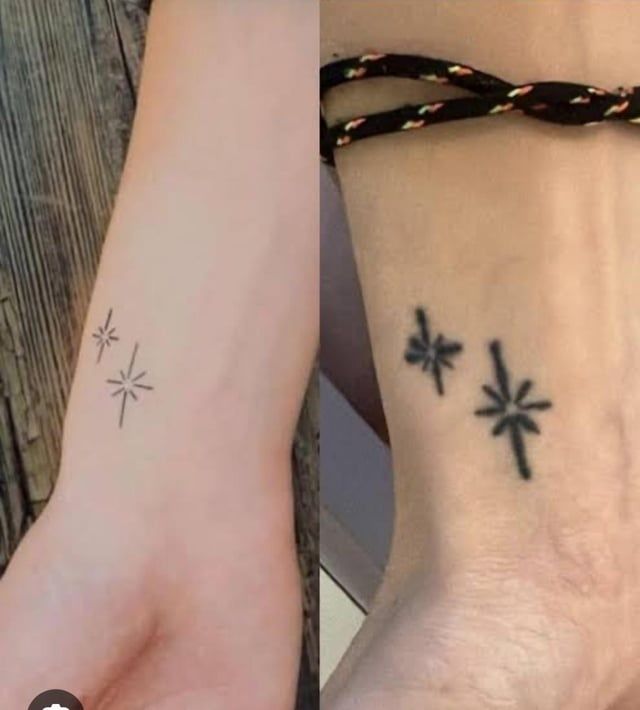
Ink migration, sometimes called ink drift, is different from ordinary softening caused by time. It occurs when pigment is deposited too deeply and reaches subcutaneous tissue, where it can spread beyond the intended line. The result may appear as a diffuse halo around a mark, often after the tattoo has healed. Thin skin, delicate scar tissue, excessive pressure, repeated passes, and individual anatomy can all increase the risk. Dark pigments, including black, blue, green, and purple, may make this spread especially visible, although pigment choice alone is not the cause.
Scarred skin requires particular care because its structure and elasticity can differ significantly from surrounding tissue. Hyper-mobile skin may move under the needle, while thin tissue offers less margin for depth control. A documented artist case involving a hand-poked design over self-harm scars described migration after delicate skin was overworked and pigment entered deeper layers. The artist allowed the area to settle for approximately ten months before using additional color to camouflage the drift. That example is not a universal treatment protocol, but it underlines the value of selecting an artist with demonstrated experience in scar work and discussing the possibility of migration before committing to intricate detail.
The most intelligent response is often design-led rather than corrective. Negative space gives a composition room to breathe if lines soften over time. Organic contours, botanical structures, constellations, flowing ornament, and other forms without rigid micro-geometric dependencies can absorb modest dispersion more gracefully than tightly packed lettering or parallel hairlines. A skilled artist can also establish a line-weight hierarchy, using the finest marks as secondary accents rather than making the entire design depend on their permanent sharpness.
- Request an honest assessment of tissue thickness, scar texture, and movement before approving the final placement.
- Choose an artist who can show healed work, not only fresh photographs.
- Leave intentional negative space around delicate marks so natural softening does not collapse the composition.
- Avoid excessive detail in areas where the skin folds, rubs, or changes shape repeatedly.
- Allow the tattoo to heal fully before judging migration, fading, or the need for revision.
Designing for the Decade Ahead with Anatomical Harmony
Long-term placement should be treated as a collaborative design exercise. The artist needs to see more than the skin”s surface. Posture, muscle tone, habitual movement, previous surgery, scars, and likely future changes all influence how a tattoo will sit in the years ahead. A stencil should be evaluated in a natural standing position, not only while the client is seated or the limb is artificially rotated. The most elegant composition is one that remains intentional when the body moves through its ordinary daily orbit.
- Study the body at rest and in motion. Check the design while standing naturally, extending the limb, flexing the joint, rotating the torso, and reproducing the movement most relevant to the placement.
- Identify the dominant anatomical axis. Use the limb, muscle direction, and visible tension pathways to decide whether the design should run longitudinally, wrap transversely, or follow a controlled diagonal.
- Build a hierarchy of line weights. Reserve the finest lines for accents and texture, while allowing primary contours enough visual authority to survive modest fading and dermal change.
- Plan for future revision without designing for failure. A touch-up may eventually be useful, but spacing, scale, and negative space should make maintenance an option rather than an emergency.
Stencil placement is where aesthetic intention meets biomechanics. On a curved surface, the artist may need to distort the stencil so the finished image reads correctly from the intended viewpoint. Symmetry marks, anatomical landmarks, and range-of-motion checks are more reliable than aligning a design to clothing seams or a temporarily relaxed posture. This is particularly important for pieces that cross a joint or wrap around a limb, where a small positional error can become obvious every time the body bends.
Mastering the Kinetic Horizon of Your Collection
The strongest tattoo collections are not assembled as disconnected images. They are curated in dialogue with the body”s architecture. Understanding Langer”s lines, tissue depth, flexion patterns, friction, and future changes does not make a design less expressive. It gives expression a stronger foundation. A celestial motif can remain expansive without being forced across a crease; a fine-line botanical can follow the quiet axis of an arm; a geometric piece can be adjusted to preserve visual balance as the body moves.
Aging should not be treated as an artistic failure. Skin changes, and the tattoo changes with it, entering a new phase of the same visual language. The sophisticated approach is to choose placement with enough anatomical intelligence that this evolution feels intentional. When design, technique, aftercare, and movement are aligned, the result is not merely ink that survives. It is a collection that remains in orbit with the person wearing it, adapting over time while retaining its original point of view.
